Introduction
For the ancient Greeks, Homer’s Iliad served as a cultural touchstone for andreia—the concept of manly courage and excellence. Alexander the Great reportedly carried a copy prepared by his tutor Aristotle into battle and modeled his own life on Achilles, the poem’s legendary warrior. Generations of men have looked to Achilles as the ultimate expression of bravery and physical power. Yet the epic also offers a quieter, more accessible example in Hector, the mortal Trojan prince who stood against the Greek army.
What Happened
Achilles appears in the Iliad as a force of nature. He is fast, strong, handsome, and seemingly fearless. His mother was a goddess, which made him a demigod and meant courage was essentially woven into his identity. He did not have to work at bravery; it was his nature. His rage and sense of honor were legendary, and they ultimately contributed to his early death, even as they secured his immortality in story.
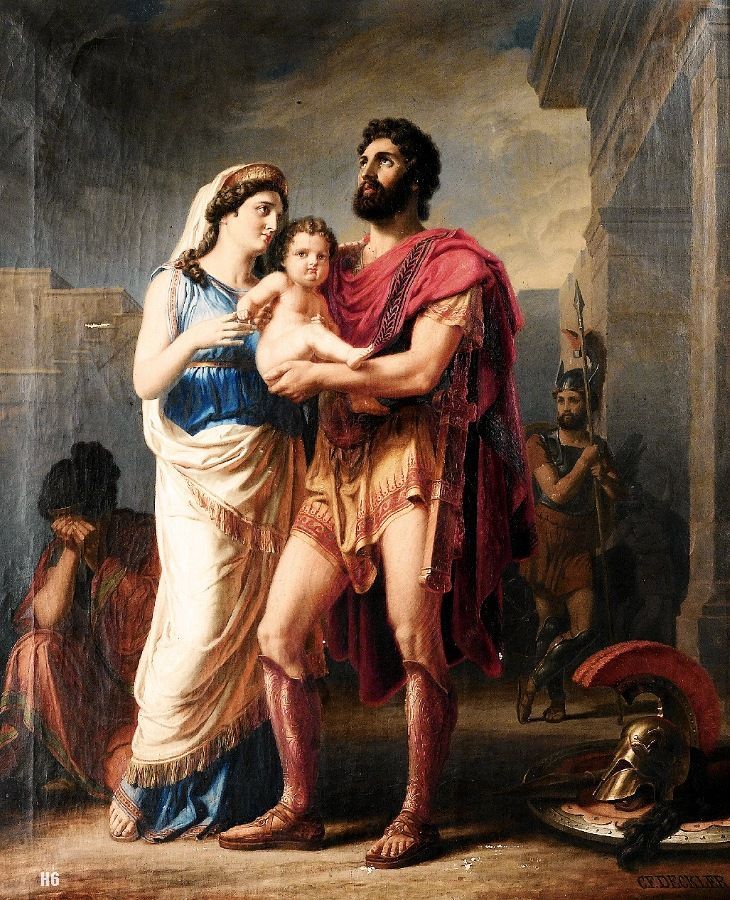
Hector presents a different picture. As a Trojan prince, he spent nine years defending his city against the Greek invasion. Unlike Achilles, Hector was entirely mortal. He did not wake up brave. In one of the most memorable scenes in Western literature, he removes his armor inside the walls of Troy and admits to his wife, Andromache, that he feels fear. He tells her that shame—not a lack of anxiety—drives him back into battle. He describes courage as something he had to learn, practicing how to stand in the front ranks and win glory for his father and himself.
The text also shows Hector’s gentler side. While other Trojans blamed Helen for the war, he treated her with kindness. And when his infant son, Astyanax, screamed at the sight of his armor stained by battle, Hector laughed, removed his helmet, and held and kissed the boy. These moments paint a portrait of a man who was compassionate and devoted to his family, yet believed that goodness had to be backed by strength.
Why This Matters
Achilles is an inspiring figure, but he is not a practical teacher for ordinary men. Because he was divine, his bravery came naturally. Asking an Achilles-type how to become courageous is like asking a world-class sprinter how to run faster—the answer is not replicable for most people. Hector, by contrast, offers a roadmap that ordinary men can actually follow. He demonstrates that courage is not the absence of fear, but the decision to act despite it.
This distinction matters because many men feel insecure when manliness does not come easily to them. The writer identifies with Hector: a good guy by nature who had to intentionally develop strength, daring, and physical capability. History is full of similar figures—Theodore Roosevelt, Frederick Douglass, Winston Churchill, and countless others—who treated manhood as a discipline to be learned rather than a trait they were born with.
Key Takeaways
- Andreia in the Iliad refers to manly courage, and Achilles represents its most famous expression.
- Achilles was a demigod, meaning his bravery was innate rather than earned.
- Hector was fully mortal and had to learn courage through practice and discipline.
- Hector admitted fear to his wife but returned to battle out of a sense of duty and shame.
- He balanced kindness and family devotion with a commitment to martial strength.
- Most men resemble Hector more than Achilles, which means intentional effort is required to develop manly virtue.
Conclusion
The Iliad presents two paths to manliness: being born with it, or learning it. For most men, the second path is the only realistic one. Hector’s example shows that courage can be cultivated, that fear does not disqualify a man from bravery, and that gentleness and strength are not opposites. By studying men who had to work at becoming courageous—figures like Roosevelt, Douglass, Churchill, and everyday fathers and mentors—anyone can begin their own education in andreia.
Discussion
Join the conversation
Thoughtful reactions, questions, and follow-up ideas help shape the next story.