Introduction
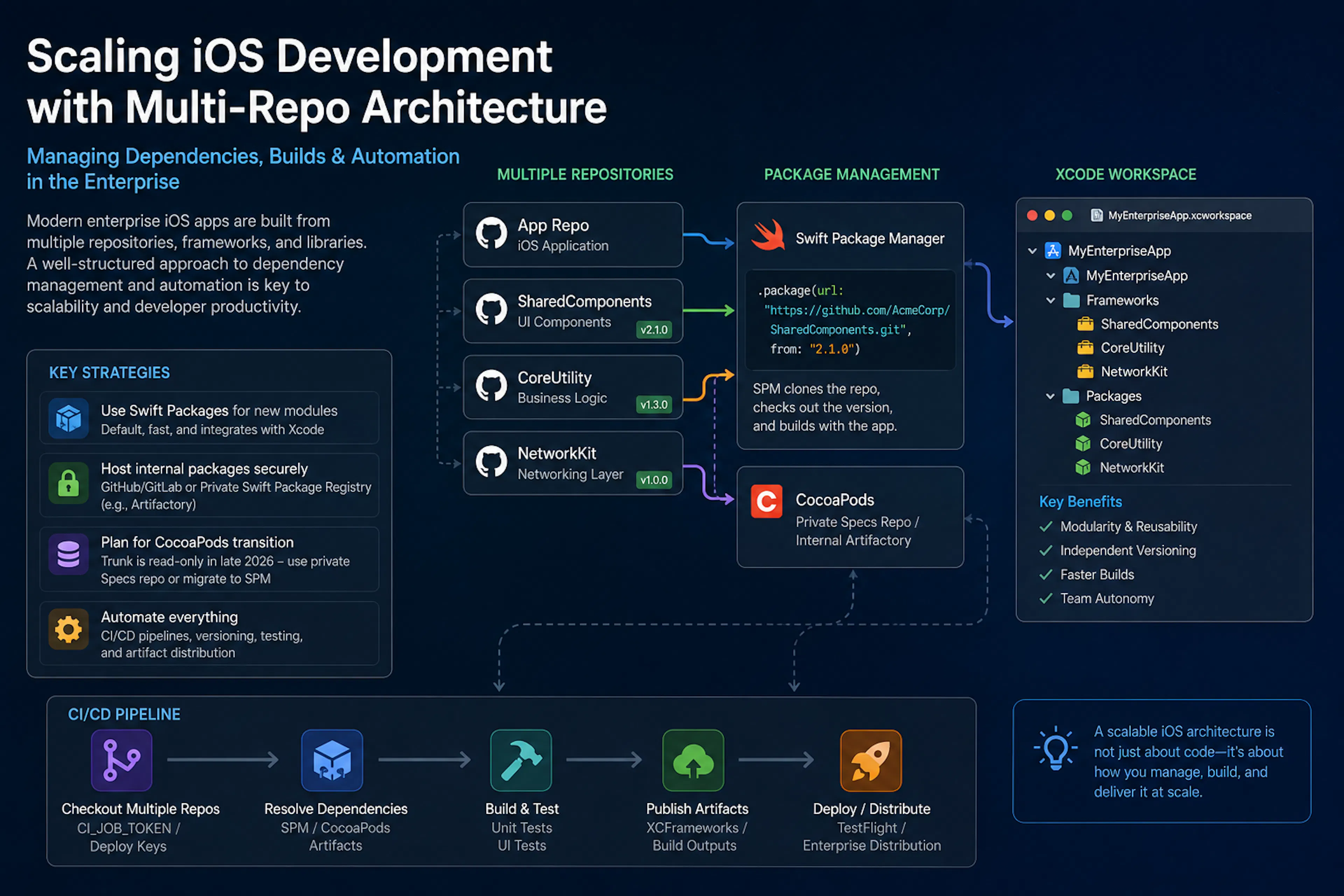
Enterprise iOS development at scale often means navigating a landscape of dozens of repositories, each housing different app targets, shared frameworks, and utility libraries. This modular approach improves access control and code organization, but it introduces complex challenges in dependency management and build coordination that require intentional strategy.
What Happened
The article explores how teams traditionally rely on Xcode workspaces and cross-project references to merge separate projects into a single build context. However, as repository counts grow, this approach scales poorly. Modern workflows increasingly turn to Swift Package Manager as the default dependency mechanism, leveraging Swift's native support for fetching and building code from external repositories. The piece also examines the retirement of the CocoaPods public Trunk, the rise of private package registries, and the growing role of binary frameworks distributed as XCFrameworks.
Why This Matters
For engineering leaders, the cost of poorly managed multi-repo ecosystems is slower builds, version drift, and fragmented developer experiences. Swift Package Manager provides a consistent, Git-first model for sharing code, while private registries like Artifactory let enterprises host packages internally, avoiding reliance on public registries and enabling faster, more controlled releases. Binary frameworks further accelerate CI by delivering prebuilt artifacts, though they trade source-level debugging for speed. Understanding these trade-offs is critical for teams balancing modularity with maintainability.
Key Takeaways
- Swift Package Manager has become the primary mechanism for adding new shared code across multiple iOS repositories
- Private Swift Package Registries and binary artifact repositories remove reliance on public package indexes
- XCFramework binaries can substantially reduce CI fetch times for stable, frequently used libraries
- Hybrid mono-repo and multi-repo configurations let teams isolate development focus while preserving overall flexibility
- Semantic version tags and precise version pinning prevent dependency drift in large-scale builds
- CI pipelines must be configured to retrieve dependent repositories and propagate exact revision information
- Uniform build settings and Swift version alignment eliminate platform-specific discrepancies
Conclusion
At scale, a multi-repository iOS codebase is maintainable when teams adopt the right combination of tools and practices. Swift Package Manager, backed by private registries or binary artifacts, becomes the linchpin of shared library management. Combined with Xcode workspaces for tightly coupled projects and automated CI pipelines that handle multi-repo checkouts, enterprises can keep dozens of repositories synchronized without sacrificing consistency or developer productivity. The result is a modular, scalable architecture where isolated development translates into reliable, repeatable production builds.



Discussion
Join the conversation
Thoughtful reactions, questions, and follow-up ideas help shape the next story.