Introduction
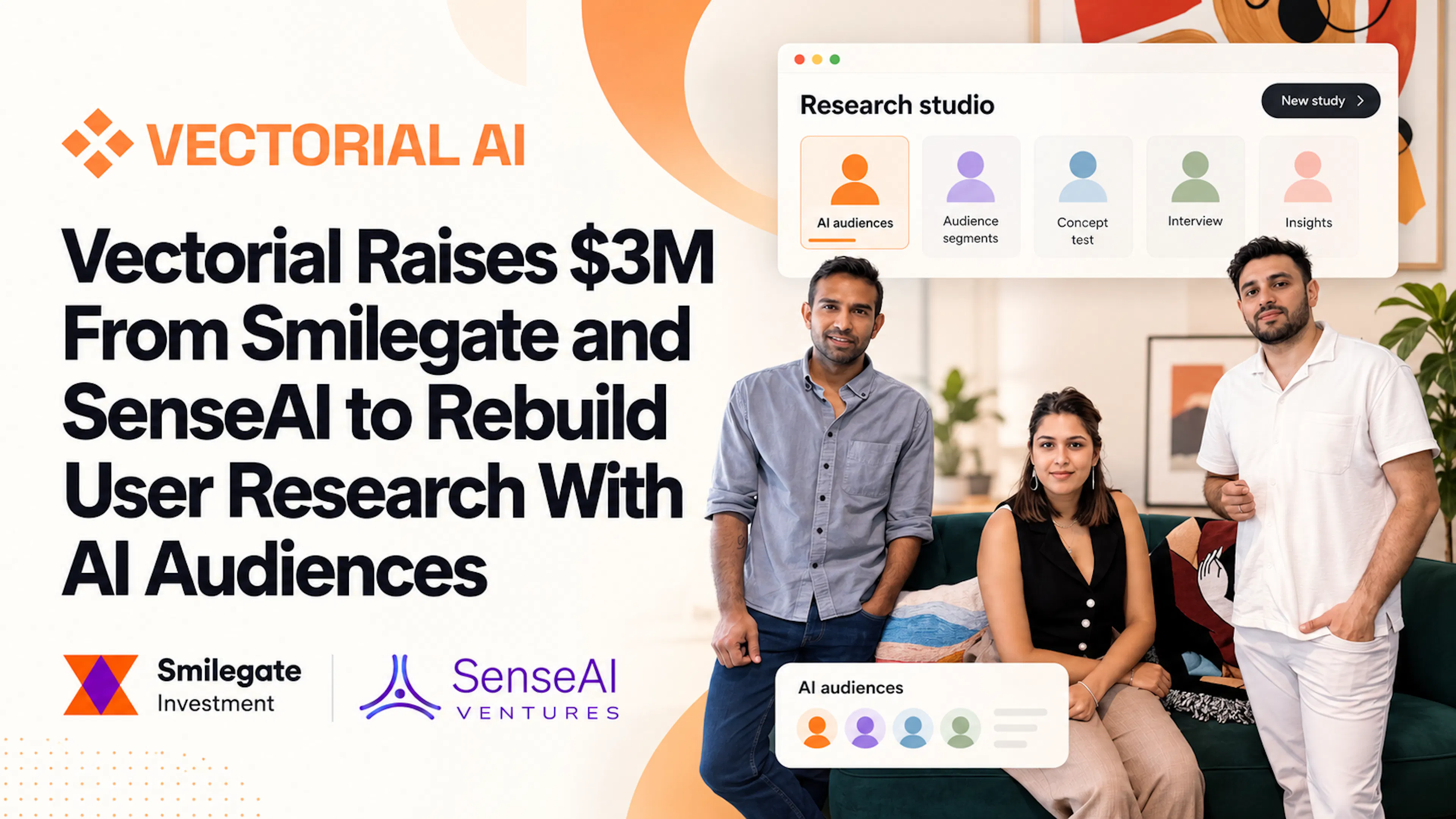
Traditional user research often stretches across weeks and costs thousands, leaving product teams to rely on instinct when speed matters most. Vectorial, a San Francisco-based startup, is reshaping that dynamic with AI-simulated audiences that deliver behavior insights in minutes rather than months. Backed by $3 million in seed funding, the company aims to replace the slow theater of surveys with continuously updated models of real customer behavior.
What Happened
Vectorial closed a $3 million seed round on October 20, with Smilegate and SenseAI Ventures leading the investment. Participation also came from UC Berkeley's Berkeley SkyDeck and AI Research Lab, Stanford-linked funds, and product leaders from Meta, Shopify, and Mastercard. The timing aligns with a broader shift in the $150 billion global insights industry, where ESOMAR data shows software-driven research segments growing faster than traditional services. A Qualtrics survey of over 3,000 market researchers found that 71% expect most future studies to use synthetic responses within three years, and 53% are already using AI regularly in their workflows. Vectorial's platform enters exactly that transition, offering a way to simulate thousands of users without recruiting, scheduling, or running live interviews.
Why This Matters
The cost of guessing early can be fatal: CB Insights found that 43% of VC-backed startups that shut down since 2023 failed due to poor product-market fit, and 70% ultimately ran out of capital. Traditional user studies take four to eight weeks and often cost $10,000 or more, while AI-moderated rounds still require five to ten days and $5,000+. Vectorial claims to deliver behavior simulations in hours for around $100. That speed gap matters for teams iterating launches in hours rather than weeks. The company's model, SAPIENS, is trained on more than 2.5 million real people and claims 30% greater accuracy than general-purpose language models, with results validated against actual user studies. If synthetic responses become the norm--as the Qualtrics data suggests--platforms that ground their models in real behavior data will hold a significant advantage.
Key Takeaways
- Vectorial's SAPIENS behavior model has simulated over 2.5 million real people and run more than 30,000 behavior scenarios.
- Early customers include publicly traded companies and billion-dollar brands such as Midi Health, GoodRx, Suki AI, boAt, Everkind, and Concrete Software.
- The platform claims to reproduce prior user-study findings with over 85% accuracy while enabling roughly 600 simulations per month--equivalent to about 40 traditional studies.
- Vectorial positions its audiences as behaviorally grounded, traceable to individual data points, and calibratable via existing CRM, survey, and analytics inputs.
- The funding will support expansion of behavioral datasets and the development of SAPIENS 2.0, with the goal of becoming the foundational simulation infrastructure for product teams.
- Investors include Smilegate, SenseAI Ventures, UC Berkeley, Stanford, and product executives from Meta, Shopify, and Mastercard, reflecting both academic and industry backing.
Conclusion
As product development accelerates, the ability to validate ideas instantly with representative, behaviorally accurate audiences could become a standard part of every launch checklist. Vectorial's approach--combining large-scale behavioral modeling with workflow-integrated simulation--positions it to lead the shift from slow, panel-based research to always-on, AI-driven insight. If the industry trajectory outlined by Qualtrics and ESOMAR holds, companies that adopt these tools early may set the standard for how products are tested, launched, and iterated in the years ahead.


Discussion
Join the conversation
Thoughtful reactions, questions, and follow-up ideas help shape the next story.