Introduction
Real-time advertising auctions operate under extreme time pressure where platforms must validate parse and decide within milliseconds. But doing unnecessary work during the bidding process degrades performance far more than most teams realize.
What Happened
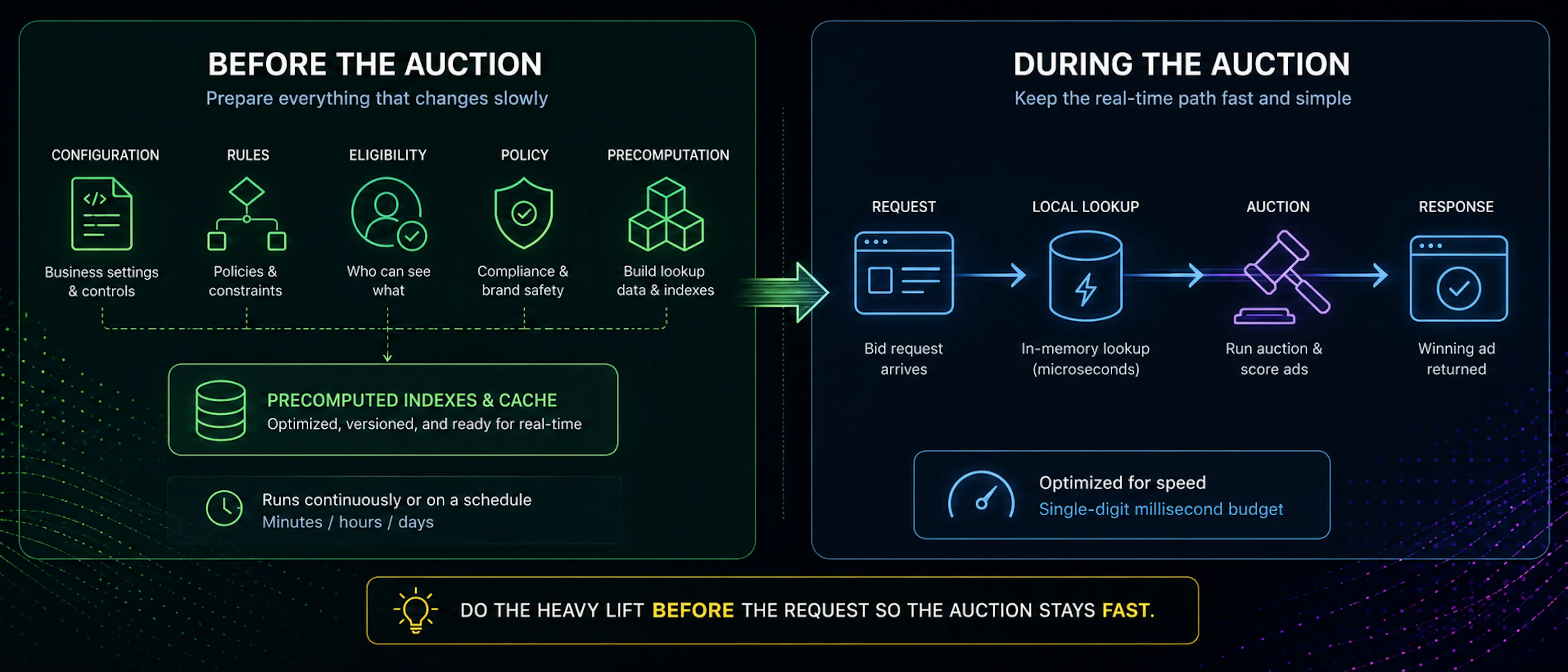
In Supply Side Platforms the auction moment is where final decisions are made but not every input requires real-time computation. Publisher settings demand partner eligibility experiment rules and regional constraints often change far more slowly than the auction traffic that consumes them. When slowly changing data is evaluated on every request the system wastes cycles on redundant work that could be eliminated through smarter architectural design.
Why This Matters
Moving slow-changing work out of the auction path transforms system reliability and cost. By separating the authoring of rules and configurations from their execution SSPs can keep the real-time path predictable reduce unnecessary remote calls and lower infrastructure expenses. The architecture shifts from optimizing individual functions to designing a system where the fast path does minimal local work.
Key Takeaways
- Pre-computing configurations and publisher settings closer to the serving path eliminates redundant real-time computation.
- Separating authoring from execution allows the authoring side to be expressive and auditable while the execution side remains compact and fast.
- Pre-computation goes beyond caching by preparing decision structures before requests arrive rather than simply reusing prior results.
- Not all requests require the same depth of validation a mature system distinguishes high-value or complex cases from routine impressions.
- Managing the trade-off between freshness and latency requires explicit versioning propagation tracking and defined staleness thresholds.
Conclusion
The fastest decision in an SSP auction is often the one the system has already made before the request arrives. Moving slow-changing work off the critical path keeping the real-time path simple and treating remote calls as expensive platforms achieve lower latency reduced cost and more predictable performance. The architectural question should always include whether work should happen at all not just whether it can run faster because the cheapest operation is the one the system never has to perform.



Discussion
Join the conversation
Thoughtful reactions, questions, and follow-up ideas help shape the next story.