Introduction
Playwright’s routing system provides a high-level way to intercept and modify network requests, but the real power emerges when you look at what the browser actually does under the hood. This article walks through request interception from Playwright’s abstracted API down to the raw browser protocols that make it possible.
What Happened
Using page.route(), developers can intercept a request before it leaves the browser, decide whether to let it proceed, block it, or serve a custom response. The article demonstrates a practical scenario: loading a local development server behind a custom domain by intercepting http://app.invalid and fulfilling it with content from localhost:3000. This technique bypasses DNS limitations and proves useful in automated testing environments.
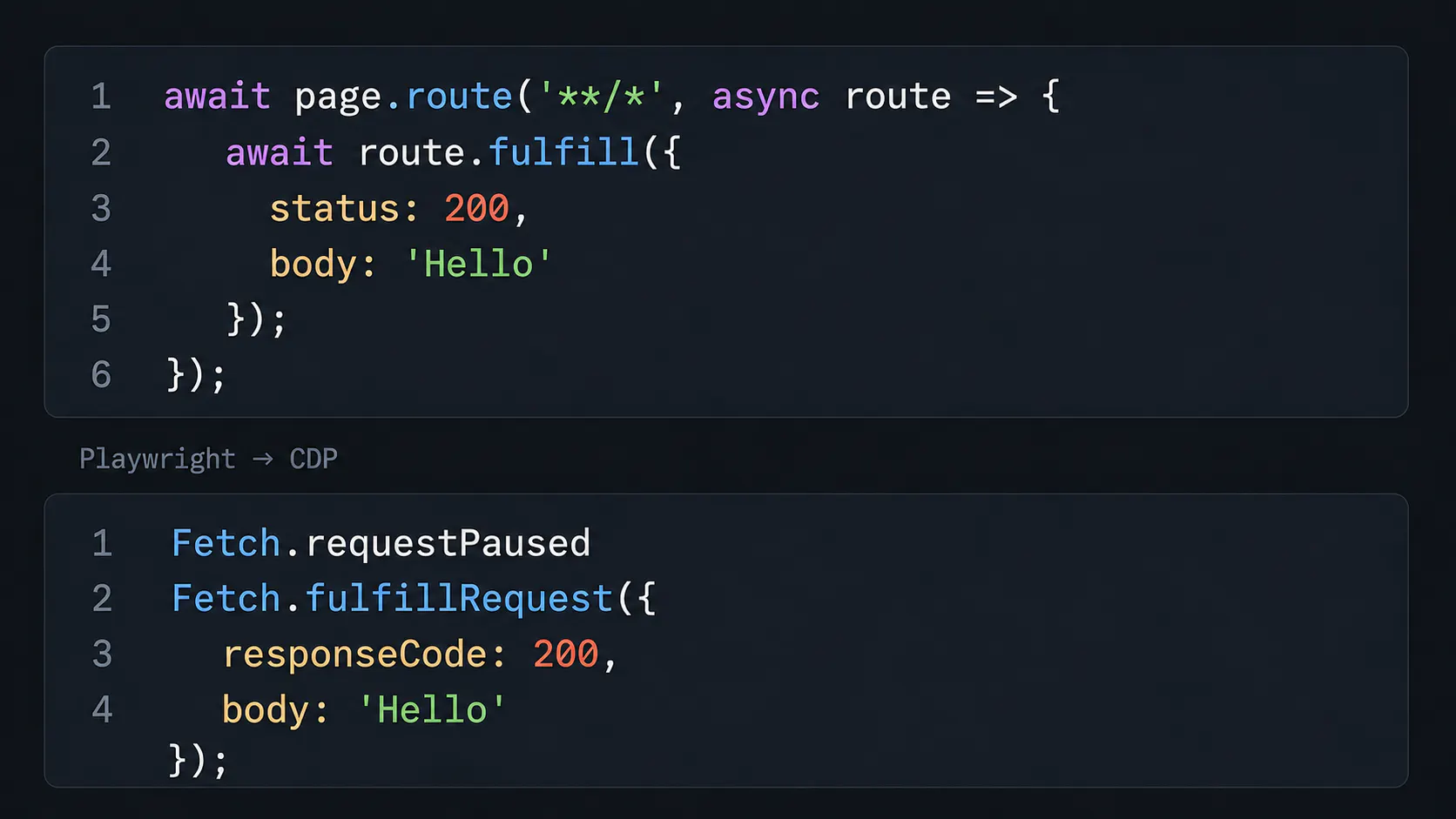
Playwright achieves interception in Chromium through the Chrome DevTools Protocol’s Fetch domain. A client sends Fetch.enable with a URL pattern, and the browser responds by emitting Fetch.requestPaused for matching requests. Playwright then decides whether to continue, fail, or fulfill the request with a custom response. The same high-level API works differently across browsers: Firefox and WebKit require patched builds because Playwright implements its own protocol layer beneath the surface.
For those who want to bypass frameworks entirely, the article shows how to connect directly to Chromium via WebSocket, send CDP commands, and handle request pausing manually. It also introduces WebDriver BiDi, a W3C working draft aimed at standardizing browser automation across engines, though it currently lacks some CDP features like CPU throttling and element quad extraction.
Why This Matters
Understanding the protocol layer becomes essential when a framework’s high-level API doesn’t expose the needed capability. Whether you’re building custom automation tools, optimizing agent workflows, or need fine-grained control over network behavior, knowing how browsers communicate gives you a significant edge.
The article highlights how protocol access can reduce noise for AI agents. By filtering network requests at the CDP level before passing data to a model, you can cut down context tokens by up to 9x. This kind of efficiency matters when every token counts in LLM-powered workflows.
It also explains why Playwright bundles custom browser binaries. Without patched builds, consistent features like request interception wouldn’t work the same way across Chromium, Firefox, and WebKit. The piece makes clear that while BiDi aims to unify this, certain CDP-specific capabilities still don’t have direct equivalents.
Key Takeaways
- Playwright’s
page.route()abstracts request interception, but the underlying mechanism varies by browser engine. - Chromium uses the Chrome DevTools Protocol’s Fetch domain, enabling fine-grained control via
Fetch.enable,Fetch.requestPaused, andFetch.fulfillRequest. - Firefox and WebKit require Playwright-patched builds to deliver consistent automation features across engines.
- Direct CDP access lets developers build narrower, more efficient tools—especially useful for AI agents where token reduction translates to cost savings.
- WebDriver BiDi is emerging as a cross-browser standard, but it still trails CDP in feature coverage, missing capabilities like element quad extraction and CPU throttling.
Conclusion
Request interception is more than a testing convenience—it’s a window into how browsers actually handle network traffic. Whether you stay within Playwright’s abstractions or drop down to the protocol level, understanding these mechanisms opens up new possibilities for custom tools, efficient agent workflows, and deeper browser insight. As browser protocols evolve, the line between high-level frameworks and low-level access will continue to shift, making it worth staying informed about what’s happening under the hood.



Discussion
Join the conversation
Thoughtful reactions, questions, and follow-up ideas help shape the next story.