Introduction
Artificial intelligence promises to transform clinical decision-making, but accuracy alone doesn't guarantee adoption. When a Midwestern hospital deployed a sepsis prediction model, nurses quickly muted the alerts-not because the math was wrong, but because the volume of notifications eroded trust. This pattern repeats across healthcare AI deployments: the real challenge isn't building better models, it's designing systems where humans and machines work together effectively.
What Happened
A sepsis prediction model rolled out across an ICU began firing alerts with such frequency that clinicians began silencing them. The model wasn't fundamentally flawed - its predictions were statistically sound - but the sheer volume created alert fatigue, causing staff to stop engaging entirely. The episode illustrates a core truth in medical AI: a technically sound system can still fail if it doesn't account for how clinicians experience and respond to its output.
Why This Matters
Healthcare demands higher stakes than most AI domains. A false negative can mean a missed diagnosis, while a false positive can trigger unnecessary treatment, added cost, and lost patient trust. Beyond individual errors, models trained on data from one hospital system often struggle to generalize elsewhere, a phenomenon known as distribution shift. The collapse of IBM's Watson for Oncology serves as a cautionary example: recommendations based on limited institutional data didn't translate across diverse clinics, and clinicians noticed quickly. These realities make thoughtful human-in-the-loop design essential, not optional.
Key Takeaways
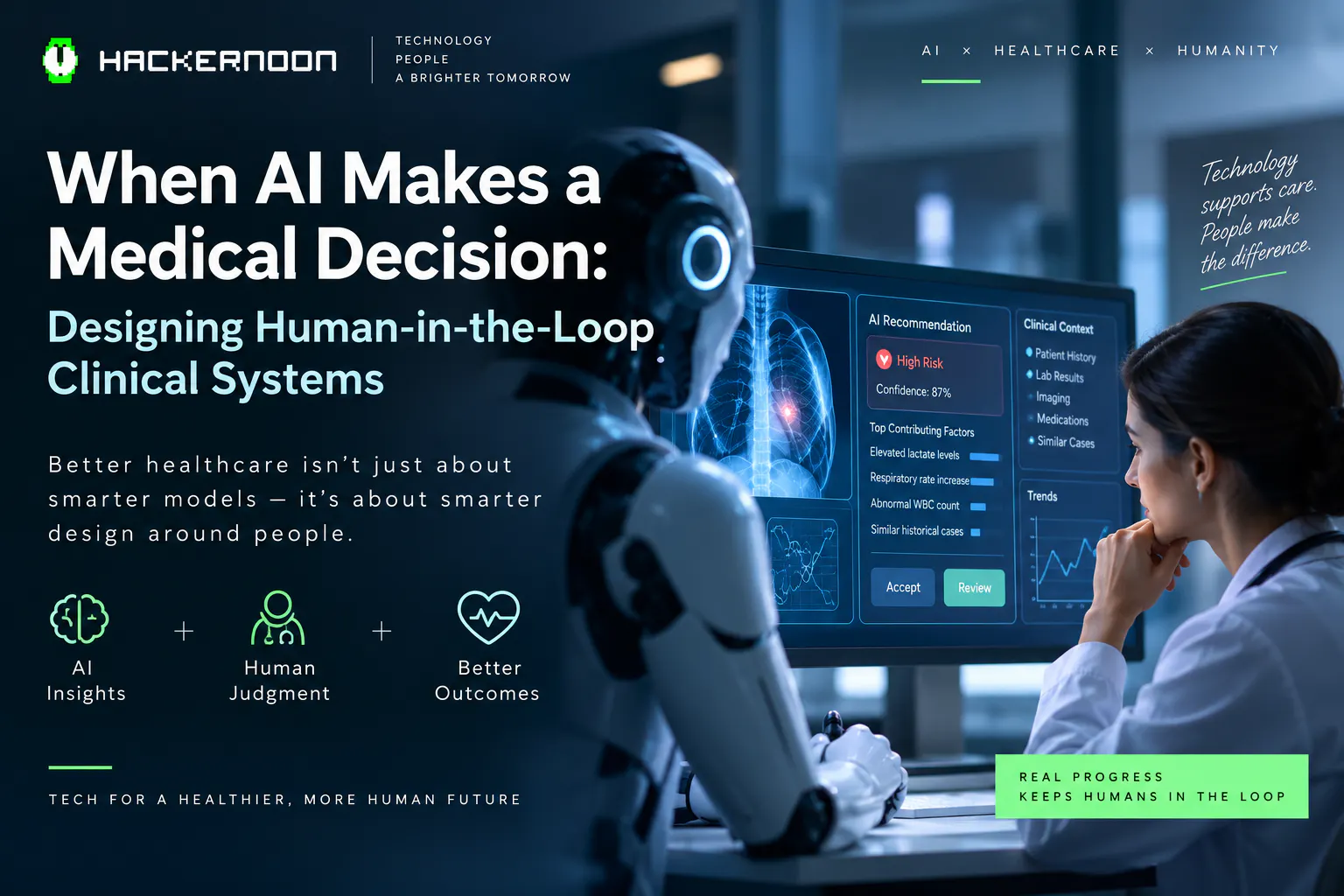
- True human-in-the-loop design goes far beyond placing a clinician's name on an approval button. It requires architecture that provides context, confidence estimates, and meaningful evaluation paths.
- Pair every prediction with a confidence or uncertainty estimate that feeds an escalation router, routing low-uncertainty outputs quietly while sending high-uncertainty or inherently high-stakes predictions (like dosing or code status changes) to clinician review interfaces that display reasoning, not just verdicts.
- Log every clinician decision and override reason; this data fuels drift detection and early model improvement rather than becoming dead weight.
- Prioritize plain-feature insights and similar historical cases over oversold interpretability tools that risk giving a false sense of understanding.
- Embed audit trails and escalation logic from day one to satisfy regulatory frameworks like the FDA's SaMD guidelines and the EU AI Act's high-risk classifications.
- Practical design means building confidence estimators as first-class components, calibrating thresholds with real clinicians present, and treating override logs as diagnostic signals, not compliance checkboxes.
Conclusion
The human in the loop isn't a limitation on AI's potential or a temporary step toward full automation. In medicine, it may be the point. Systems that respect clinician context, surface meaningful uncertainty, and log every interaction earn trust where flashy accuracy numbers alone cannot. For anyone building clinical AI, the most powerful metric isn't model performance in a vacuum - it's whether the clinicians using it actually want to keep it running.



Discussion
Join the conversation
Thoughtful reactions, questions, and follow-up ideas help shape the next story.