Introduction
Artificial intelligence agents are increasingly entering the workplace, handling everything from email to code repositories. As these personal agents integrate with enterprise systems, they inherit employee-level access, creating new security blind spots. Aembit addresses this challenge by extending its identity control platform to personal AI agents, ensuring secure, policy-driven access without disrupting daily operations.
What Happened
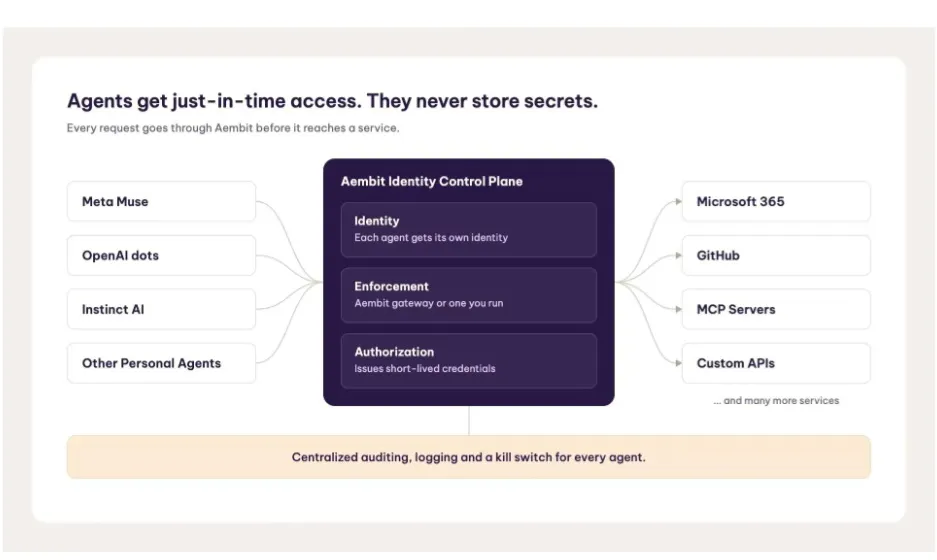
Aembit announced support for securing personal agents' access to enterprise environments, available immediately to existing customers at no extra cost. The platform introduces a blended identity model that combines the agent's distinct profile with the employee it represents. Supported agents include Meta Muse, OpenAI Dots, and major platforms like ChatGPT, Gemini, Claude, and Microsoft Copilot Studio. The solution enables runtime access evaluation, short-lived credentials, and centralized audit trails.
Why This Matters
When personal AI agents gain enterprise access through employee credentials, risks escalate: sensitive data exposure, unauthorized changes, and activity that's hard to distinguish from normal user behavior. Credentials stored outside security control further amplify these threats. Aembit's approach replaces standing secrets with temporary, scoped access and allows security teams to revoke a single agent without affecting the employee's account. This shifts access control from static permissions to dynamic, context-aware enforcement.
Key Takeaways
- Each agent receives a distinct identity separable from its user.
- Access policies are evaluated at runtime, considering agent, user, resource, and conditions.
- Short-lived credentials replace reusable secrets held by agents.
- Controls extend across SaaS, developer platforms, and internal services.
- All access activity is centrally recorded and auditable.
- Security can disable individual agents without resetting employee credentials.
- Policy enforcement works via Aembit's gateway or existing infrastructure.
Conclusion
As AI agents become standard workplace tools, securing their enterprise access is non-negotiable. Aembit provides the identity framework and policy engine needed to let organizations adopt personal AI safely. By giving agents their own identity, enforcing runtime access, and enabling centralized revocation, Aembit turns a potential security liability into a manageable, governed component of modern AI-driven work.


Discussion
Join the conversation
Thoughtful reactions, questions, and follow-up ideas help shape the next story.