Introduction
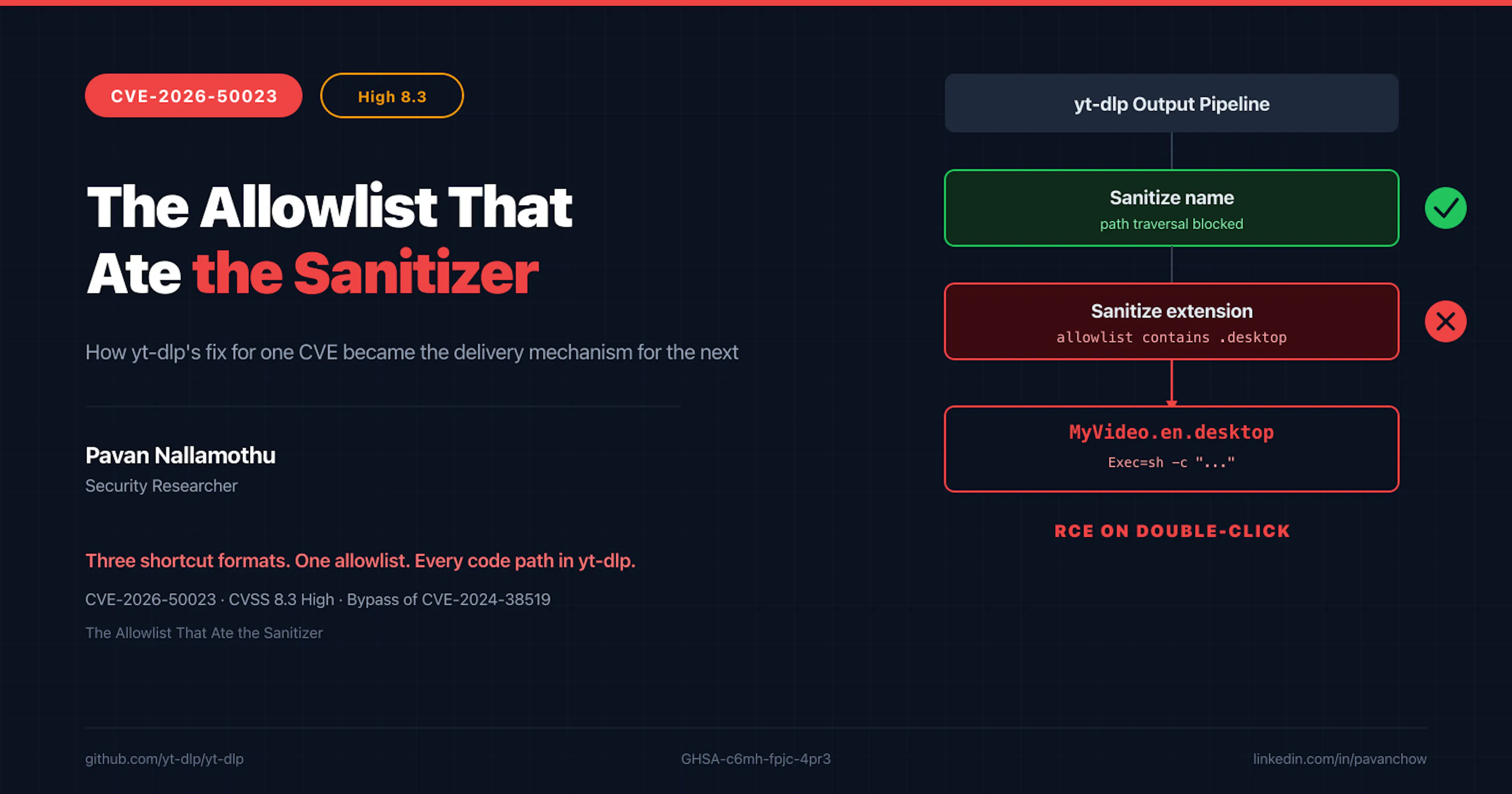
Security researchers often track CVEs as isolated incidents, but sometimes a single flaw reveals a recurring pattern. CVE-2026-50023 in yt-dlp is one such case, tracing back to a global allowlist that quietly permitted dangerous file extensions. The vulnerability allowed attackers to plant .desktop files alongside legitimate downloads, relying on a double-click to trigger code execution.
What Happened
The issue stems from yt-dlp's sanitize_extension function, which maintained a global allowlist of permitted file types. Among them were .desktop .url and .webloc placed alongside common media extensions like .srt and .mp4. The intent was to support the --write-link feature which generates platform-specific shortcut files on user demand. However the allowlist was not scoped to that feature alone. Any extractor deriving an output extension from remote metadata could trigger the write even without --write-link being invoked. The attack vector involved an HLS master manifest containing a subtitle track with a URI ending in .desktop. yt-dlp would parse the manifest extract the subtitle URI and use its file extension as the output filename. Since .desktop was on the allowlist the file was written to the user's download directory. The file bore a subtitle-like name and on GNOME and KDE the .desktop extension was hidden by default. A single double-click executed the Exec= line launching an arbitrary shell command at the user's privilege level.
Why This Matters
The vulnerability affected any yt-dlp version before 2026.06.09. Because the exception lived in a central utility rather than at the feature boundary every code path that selected an output extension inherited the permission. The flaw underscores how a pragmatic fix for one feature can outgrow its original scope and become a systemic risk. The follow-up CVE-2026-55404 fixed less than a month later showed that the same class of bug kept resurfacing at different layers. For end users the risk is real: a seemingly harmless subtitle download could drop a hidden executable next to their media files. For maintainers its a case study in where exceptions should live and why global sanitizers should rarely grant special permissions.
Key Takeaways
- The bug was caused by three extensions desktop url webloc residing in a global allowlist meant for a specific feature.
- Attackers could exploit HLS subtitle URIs to write .desktop files without user consent.
- Double-clicking the file on Linux desktops triggered remote code execution at the user's privilege level.
- The fix removed those extensions from the global list and moved the exception to the --write-link boundary.
- A follow-up CVE two months later confirmed that the underlying mental model needed to shift: any string reaching a shortcut file must be treated as executable content until proven safe.
- Users should keep yt-dlp updated and be cautious about downloading subtitles from untrusted sources.
Conclusion
CVE-2026-50023 is a reminder that security fixes live and die by where they are placed. When an exception is carved into a shared utility it quickly becomes harder to track harder to audit and easier to exploit. The yt-dlp team's response moving the exception to the feature boundary and tightening validation at the point of output shows the right way to handle it. For the broader community its a prompt to review any sanitizer or allowlist that grants special privileges behind a global flag and ask whether the exception belongs at the edge not the center.

Discussion
Join the conversation
Thoughtful reactions, questions, and follow-up ideas help shape the next story.