Introduction
The Federal Reserve has released its first dedicated examination of how the artificial intelligence infrastructure boom is being funded, and the numbers are striking. In its November Financial Stability Report, the central bank identified more than $3 trillion in AI-related financial commitments that sit off the balance sheets of seven major technology companies. These obligations—ranging from unsigned leases to long-term service guarantees—do not appear as traditional debt, yet they could shape financial stability if AI investment slows.
What Happened
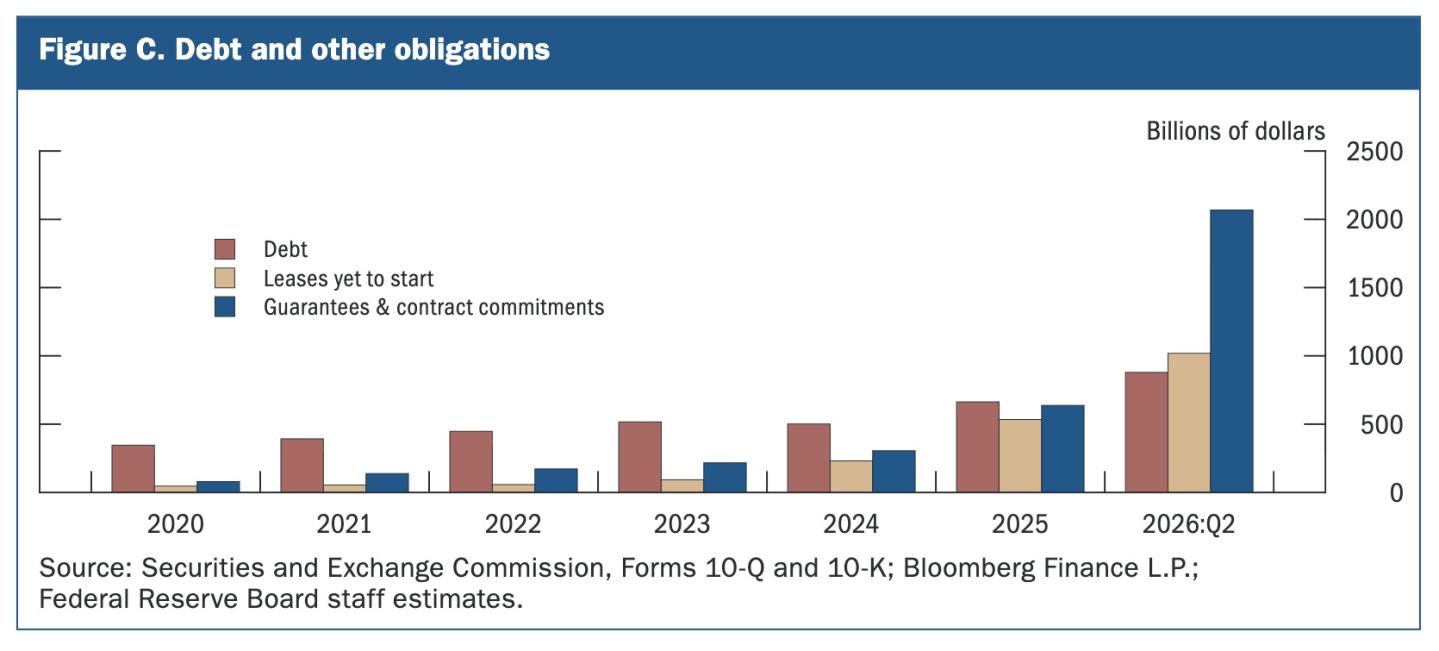
The report’s new section, “Leverage in the Data Center Buildout,” marks a departure from previous editions dating back to 2024. Fed Governor Michael Barr discussed the findings during a speech in Milan, placing the potential maximum nominal value of these obligations above $3 trillion. The figure includes more than $1 trillion in leases that have been signed but have not yet commenced, along with over $2 trillion in take-or-pay contracts and residual value guarantees.
The companies involved are Amazon, Alphabet, Broadcom, Meta, Microsoft, Nvidia, and Oracle. Meanwhile, the seven firms’ conventional on-balance-sheet debt is projected to surpass $800 billion by the end of the year. The Fed was careful to note that the off-balance-sheet figures are undiscounted and should not be compared directly with standard debt.
Separately, the central bank found that debt issuance linked to advanced computing reached more than $680 billion by October—roughly five times the $130 billion issued throughout 2023. Advanced computing now accounts for about 31% of nonfinancial investment-grade corporate debt issuance, up from under 6% in 2023.
The timing coincides with leadership changes at Nvidia. CEO Jensen Huang resigned on November 12, and CFO Colette Kress stepped in as interim chief executive. Nvidia’s own filings illustrate the type of commitment the Fed is tracking: a residual value guarantee tied to an AI campus in Pike County, Ohio, where an OpenAI affiliate is expected to anchor roughly 4.25 gigawatts of IT load. If OpenAI defaults, Nvidia would cover the gap between the lease’s guaranteed minimum value and any recovery, with total exposure cumulatively capped at $105 billion for the initial commitment. OpenAI has agreed to reimburse Nvidia for any payments.
Why This Matters
The structure of these arrangements raises questions about who absorbs losses if AI demand disappoints. Companies with strong credit ratings can back weaker-credit projects without an immediate impact on their own balance sheets. Data-center developers use these leases to fund construction, while the riskier portions of the underlying debt are held by high-yield bond funds, life insurers, business development companies, and other private credit vehicles.
According to the Fed, the largest U.S. bank holding companies hold nearly $1 trillion in exposure to large technology firms, data-center developers, AI-related special purpose entities, private credit funds, and utilities. Governor Barr warned that this opacity could worsen selloffs when market sentiment shifts, because it becomes difficult to pinpoint where risk is concentrated.
Fed Chair Kevin Warsh added that Board staff have begun modeling AI scenarios, ranging from a sustained growth boom to a significant disappointment in AI adoption.
Key Takeaways
- The Fed identified over $3 trillion in off-balance-sheet AI commitments at seven major tech firms.
- The total includes more than $1 trillion in not-yet-started leases and over $2 trillion in contracts and guarantees.
- On-balance-sheet debt for these companies is expected to exceed $800 billion before year-end.
- Debt tied to advanced computing has surged to more than $680 billion by October, up from $130 billion in all of 2023.
- Roughly 87% of Fed market contacts now view AI as a notable financial-system risk, up from 50% in May.
- Nvidia’s residual value guarantees, including a $105 billion cap tied to an Ohio AI campus, illustrate the scale of these obligations.
Conclusion
The Federal Reserve’s first close look at AI financing does not predict a banking collapse. Governor Barr said direct losses remain a limited concern given the current scale of debt backing the boom, and the central bank described the U.S. banking system as sound and resilient. Still, the report highlights a visibility gap: the economic exposure of the largest tech firms may be substantially larger than what their balance sheets suggest.
The Fed plans to release its next Financial Stability Report in the spring. Until then, investors, regulators, and policymakers will be watching whether the AI buildout’s off-balance-sheet obligations remain manageable or become a source of broader financial strain.
Discussion
Join the conversation
Thoughtful reactions, questions, and follow-up ideas help shape the next story.